
Flexible Trading Arrangements Metering Explained: Direct Spot Market Access for Flexible Loads
From 1 November 2026, the new Flexible Trading Arrangements (FTA) metering introduced by the Australian Energy Market Commission (AEMC) gives flexible loads, such as batteries, direct access to the wholesale spot market. By installing an FTA meter upstream of the flexible load, a second National Metering Identifier (NMI) is established at the site. The battery can then charge and discharge in response to spot prices rather than being limited by the peak- and off-peak structure of the site’s main NMI. This video explains how the new metering structure works, and what the rule means for Commercial and Industrial (C&I) customers compared to Small and Medium Enterprises (SME).
Key Insights
An FTA meter establishes a second NMI that gives a flexible load direct spot market access.
C&I customers can appoint a separate retailer on the FTA load.
The main NMI stays with the existing retailer while a second retailer optimises the battery directly on the spot market, opening the door to testing different strategies with retailers geared for flexible load solutions.
SME customers keep one retailer across both NMIs.
The retailer covers the main meter and the FTA load together and passes the benefit generated by the flexible load back to the customer over the billing period.
The framework is locked in, with commencement on 1 November 2026.
The AEMC made the rule in August 2024, and AEMO finalised the supporting market procedures in September 2025, which is why NGG is engaging early adopters now to develop business cases ahead of commencement.
How the Flexible Trading Arrangements Metering Works
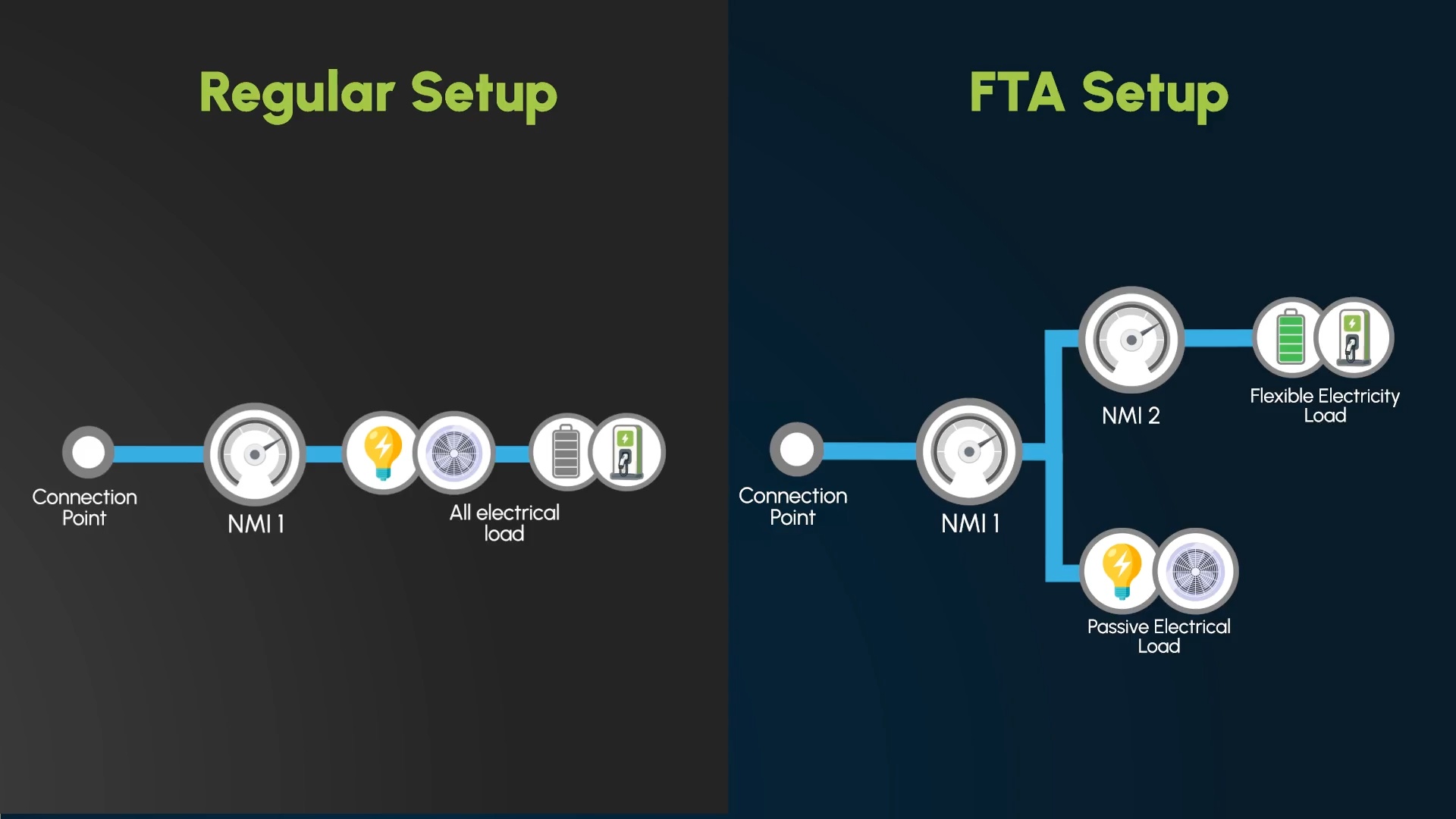
Under a regular setup, a site has one connection point and one NMI. Everything downstream of that meter, from lighting and air conditioning through to a battery or EV charger, sits on the same tariff structure. A battery in that position can only respond to the site’s retail rates, typically peak and off-peak, no matter what the wholesale market is doing.
The FTA rule changes that structure. An FTA meter installed upstream of the flexible load establishes a second NMI at a secondary settlement point (SSP) behind the site’s existing connection point, with no separate network connection required. The passive loads stay on the main NMI exactly as before. The flexible load now sits behind its own NMI with direct exposure to wholesale spot prices.

That separation is what unlocks the value. The battery charges in the middle of the day when abundant solar generation pushes spot prices down, and discharges when demand rises and the grid needs energy most. The asset operates freely to maximise its value and, in doing so, indirectly supports the grid.
What the Flexible Trading Arrangements Mean for C&I Customers
For C&I or businesses with large annual electricity usage, the most significant feature of the rule is retailer separation. The main NMI can remain with the site’s existing retailer under its current arrangement, while an entirely separate retailer is appointed on the FTA load.
That second retailer can optimise the battery directly against the spot market as its sole focus. The existing retailer’s role doesn’t change. For C&I energy managers, this creates room to trial different strategies on their flexible loads and to work with retailers specifically geared toward these solutions, without affecting the supply arrangement for the rest of the site.
For Small and Medium Enterprises (SME), the structure is simpler: the retailer at the main NMI must also be the retailer at the FTA load. One retailer covers both meters and passes the benefit the flexible load generates back to the customer through the billing period.

Follow 30in30 and get early access to the next video
When the Flexible Trading Arrangements Start
The AEMC made the rule in August 2024, and AEMO finalised the supporting market procedures in its final report published in September 2025. The framework is settled. The arrangements for flexible loads, such as batteries, commence on 1 November 2026.
With the rule locked in, the question for energy users is no longer whether it’s coming but how their sites can capture the value when it does. Next Green Group is already helping early adopters figure out what the rule means for their sites, so that when the rule takes effect, the strategy is already in place. If you’re interested in doing the same for your site, get in touch!
Watch Next

Optimising a Multi-tenant Site with Solar & Battery (Part 1)

Optimising a Multi-tenant Site (Part 2): Spatial Engineering & VPP Readiness

Optimising a Multi-Tenant Site (Part 3): Switchboard Conversion & Future-Proofing

Optimising a Multi-Tenant Site (Part 4): Maximising Solar Carport Site Footprint
What is the 30in30 initiative?
This video is part of Next Green Group’s 30in30 initiative. We’ve committed to deploying 30 Megawatt-hours of behind-the-meter commercial & industrial (C&I) battery storage across Australia over the next 30 months. We’re opening our internal playbooks to show C&I leaders the engineering and financial reality, empowering them to navigate the energy transition confidently.
Next Green Group is a vertically integrated energy solutions provider delivering complete asset lifecycle management. With 14 years of industry experience and more than 15,000 energy projects delivered, we bridge the gap between behind-the-meter energy infrastructure and front-of-meter wholesale market dynamics through our retail energy arm, Next Business Energy. We engineer, construct, and provide ongoing operations and maintenance for commercial energy assets to strict ISO & Australian standards. Backed by global powerhouse Sojitz Corporation, we combine this technical execution expertise with structured financing solutions to remove capital barriers and ensure long-term commercial performance.