Next Green Group 30in30 Logo

You're Subscribed!

Thanks for joining the 30in30 journey. You'll receive upcoming insights, videos, and resources directly in your inbox.

Whats Inside a Commercial Battery System

Inside a Commercial Battery Storage System: The Components of a C&I BESS

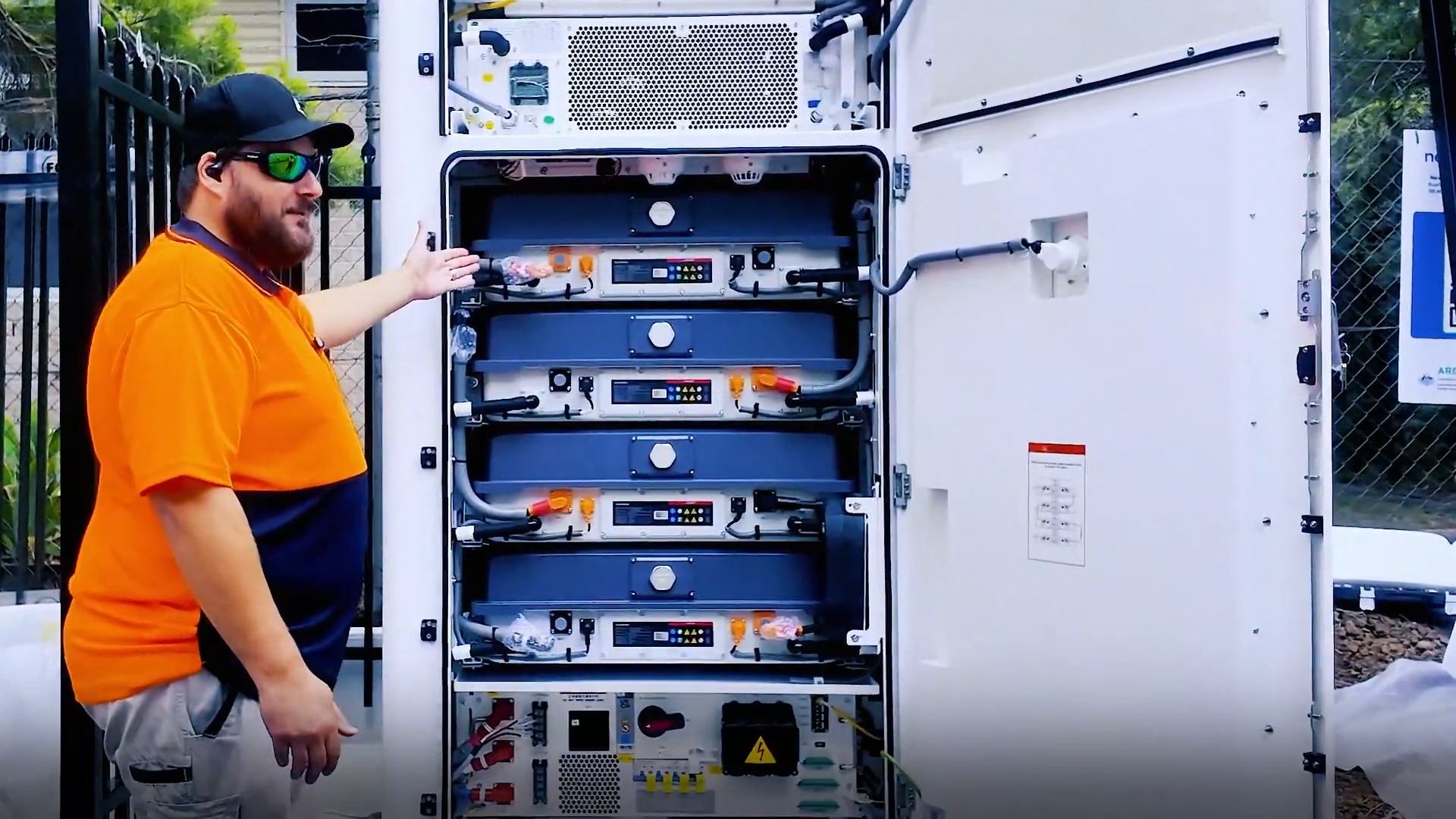
A commercial battery storage system’s performance, lifespan, and safety are largely determined by components the owner rarely sees: modular battery packs, a power conversion system, an active liquid cooling system, an energy management system, and a multi-layered fire safety setup, all factory-integrated in one pre-assembled cabinet that keeps on-site engineering minimal. What’s inside determines what the asset can capture from the spot market and how long it can continue to perform. This video opens up a Sungrow 110kW / 225kWh unit moments after it was lowered into position at our live Albion Park project site, and walks through what each system does and why it matters.

Five Systems in One Cabinet

The unit in this video is a Sungrow 110kW / 225kWh commercial energy storage system. All five systems share a single outdoor-rated cabinet, integrated and tested before the unit arrives on site.

Power conversion system (PCS)

At the top of the cabinet sits the power conversion system, the integrated inverter that converts between DC and AC. Its efficiency determines how much stored energy survives the round trip, and its response speed determines whether the asset can capture wholesale spot market price spikes when they happen.

Active Liquid Cooling

Running throughout the unit is the temperature management system, pumping coolant through every battery pack. It works in both directions, heating in winter and cooling in summer, holding the cells at their optimal operating temperature. Temperature extremes are the main driver of accelerated cell degradation, so this system directly protects the asset’s capacity and lifespan.

Energy management system and power distribution

The bottom section houses the controls: the energy management system (EMS), the input and output interfaces to the fire system, the monitoring system, and the power distribution box. This is the intelligence layer that enables automated, continuous trading against the wholesale market once the unit is commissioned.
Commercial battery storage system diagram showing the PCS, liquid cooling, modular battery packs and EMS section | Next Green Group

Follow 30in30 and get early access to the next video

Sign up to be the first to access new videos before they go live to the public.

How Commercial Battery Storage Protects the Building Around It

A battery installed at an occupied commercial site carries safety obligations beyond the unit itself, and the protection here operates in layers.

Inside the cabinet, an inbuilt aerosol fire suppression system responds directly to any thermal event. Around it, smoke detectors and temperature sensors are wired into the building’s own smoke and fire alarm system. Any fault is registered through the same channels as every other safety event in the building, which means the owners and the fire brigade know about it, without relying on anyone to check a separate monitoring portal.

From Delivery to Commissioning

Because the cabinet arrives pre-assembled and factory-tested, the on-site work is contained. At Albion Park, the unit was craned into position over a floor conduit that had already been aligned to the cabinet’s gland box. From there, the remaining steps are to terminate the cables, commission the unit, and connect it to the battery switchboard.

This project received Community Batteries Round 1 funding from the Australian Renewable Energy Agency (ARENA) under its Advancing Renewables Program.

The views expressed herein are not necessarily the views of the Australian Government, and the Australian Government does not accept responsibility for any information or advice contained herein.

Follow 30in30 and get early access to the next video

Sign up to be the first to access new videos before they go live to the public.

Watch Next

See what a commissioned commercial battery does commercially in our Charlestown series, or learn how the upcoming Flexible Trading Arrangement rule changes what these assets can earn.
Optimising a Multi-tenant Site with Solar and Battery - Next Green Group 30in30

Optimising a Multi-tenant Site with Solar & Battery (Part 1)

Optimising a Multi-tenant Site (Part 2) Spatial Engineering & VPP Readiness - Next Green Group 30in30

Optimising a Multi-tenant Site (Part 2): Spatial Engineering & VPP Readiness

Optimising a Multi-tenant Site (Part 3) Swtichboard Conversion & Future-Proofing - Next Green Group 30in30

Optimising a Multi-Tenant Site (Part 3): Switchboard Conversion & Future-Proofing

Flexible Trading Arrangement Rule Explained | 30in30 | Next Green Group

Flexible Trading Arrangement Metering Explained

What is the 30in30 initiative?

This video is part of Next Green Group’s 30in30 initiative. We’ve committed to deploying 30 Megawatt-hours of behind-the-meter commercial & industrial (C&I) battery storage across Australia over the next 30 months. We’re opening our internal playbooks to show C&I leaders the engineering and financial reality, empowering them to navigate the energy transition confidently.

Next Green Group is a vertically integrated energy solutions provider delivering complete asset lifecycle management. With 14 years of industry experience and more than 15,000 energy projects delivered, we bridge the gap between behind-the-meter energy infrastructure and front-of-meter wholesale market dynamics through our retail energy arm, Next Business Energy. We engineer, construct, and provide ongoing operations and maintenance for commercial energy assets to strict ISO & Australian standards. Backed by global powerhouse Sojitz Corporation, we combine this technical execution expertise with structured financing solutions to remove capital barriers and ensure long-term commercial performance.