 1300 419 559


Flexible Trading Arrangements
Unlock more value from your commercial battery
From 1 November 2026, your commercial battery can do more than reduce energy use.
✓ Trade in the wholesale market
✓ Manage demand charges
✓ Complement your existing energy assets
It’s a new reason to look at battery storage, or expand what you’ve got.
Get started with a strategy call to explore FTA for your site
Book a FTA strategy session
What are Flexible Trading Arrangements?
Flexible Trading Arrangements (FTA) are a national electricity market rule that lets a flexible load, such as a battery, access the wholesale spot market directly. The rule was developed by the AEMC, the market procedures were finalised by AEMO, and the arrangements relevant to flexible loads commence on 1 November 2026.
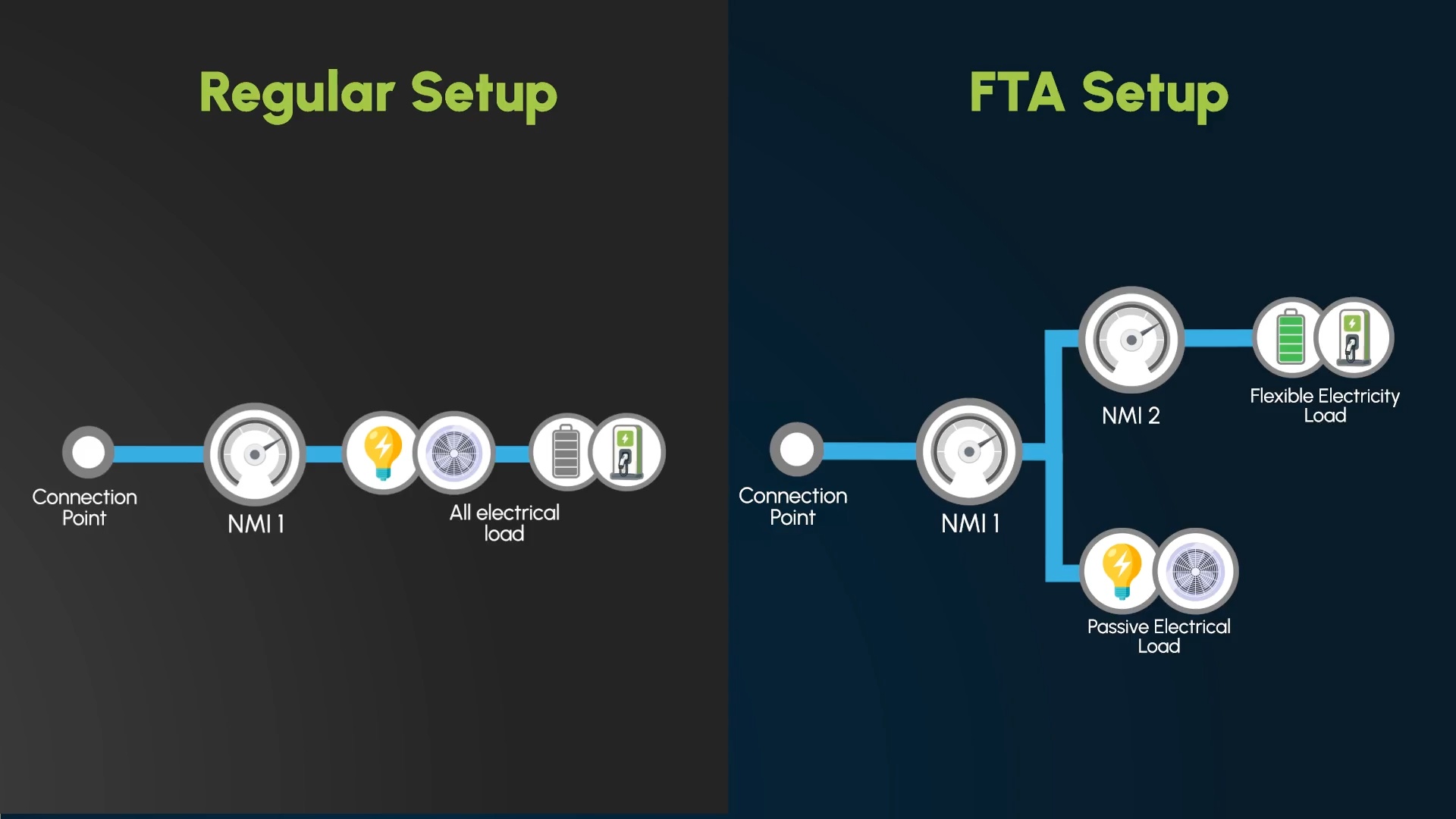
Today, everything on a business site sits behind one connection point and one meter. FTA gives the battery its own market access through a second meter, so it can charge when wholesale prices are low and discharge when they’re high. No new network connection is needed, and existing loads stay where they are.
Some sites will see a strong case for FTA, while others won’t. Book a strategy session to see if FTA is a good fit for your site.
Watch this 3-minute video on the rule and how the setup works
More in the FTA series
We’re sharing FTA insights from our own projects, real examples, and answers to the questions we hear most.

Three Flexible Trading Arrangements Benefits

Defining Commercial Battery Objectives Before You Invest?

Combining FTA with Other Government Schemes (PDRS & SRES)
Three Questions You Should Ask Before a Battery Build
6 Components of an FTA Setup
FTA-ready Battery Project
How FTA Works
Solar stays on the main connection, reducing what the site procures from the grid, optimising self-consumption. The battery sits on the second meter, free to respond to wholesale prices. The site keeps running as it always has.
Large customer or small customer: which applies to your site?
The FTA rule treats sites differently depending on whether you’re classified as a large or small customer, and that classification is based on your site’s annual electricity consumption.
If your site is a large customer, you can establish a secondary settlement point and appoint a separate retailer or energy service provider on the flexible load, while the rest of your site stays with its existing retailer. That’s what opens the door to providers built specifically for flexible-asset trading. Most commercial and industrial (C&I) sites sit on the large customer side.
If your site is a small customer, you can still separate the flexible load from your passive loads, but a single retailer covers both. The benefit comes back to you through your billing arrangement rather than through a separate market relationship.
Confirming which side your site falls on is the first practical step, and it’s one of the things we work through in a complimentary strategy session.
Why Work with Next Green Group on FTA
FTA sits at the intersection of two worlds: behind-the-meter battery engineering and front-of-the-market wholesale market trading. Most providers do one or the other, or partner with another provider to provide both. Next Green Group has the in-house capability for both.
That matters because FTA has more moving parts than a standard battery project, and every gap between providers is a risk you end up carrying. Here’s the full chain, and we handle all of it.
The strategy
What your site is trying to achieve, and what that means the flexible load needs to do. Your objectives and site needs decide how FTA gets optimised, not the other way around.
Add a battery, or expand the solar and storage you already have, sized to the outlined energy strategy and available data rather than assumptions.
Revenue-grade metering and retailer licensing through our retail arm, Next Business Energy. NBE is a business energy specialist, so the retail side of FTA isn’t a handoff to a third party. It’s the same team.
Virtual Power Plant (VPP) setup that monetises the battery on the spot market, co-optimised against your site’s demand charges rather than chasing one at the expense of the other.
Government incentive programs shift regularly across federal and state schemes. We keep track of what your site qualifies for and build it into the numbers. If you prefer not to fund it upfront, our in-house financing is also available.
Operations & Maintenance (O&M) and Asset Optimisation programs that keep the flexible asset performing at its best across its life, recalibrated as your site’s load profile, needs, and objectives change over the years.
We’re a vertically integrated energy provider with 14 years of experience and more than 15,000 various energy projects delivered nationally. FTA is complex, but our job is to give you certainty over that complexity, with one team accountable for the whole picture.
You don’t have to work out which parts of that chain your site needs on your own. Get in touch with our team for a complimentary strategy session.
What a battery can do under FTA
Trade the wholesale market
The battery charges when prices are low and discharges when they’re high, capturing a profit that standard retail tariffs miss out.
Manage demand charges
Our VPP layer weighs spot value against demand charge risk at the main connection point, so the two are co-optimised rather than working against each other.
Complement existing energy assets
Our control layer weighs spot value against demand charge risk at the main connection point, so the two are co-optimised rather than working against each other.